Showing posts with label PV Narsimha Rao. Show all posts

Wednesday, July 08, 2015

Book review: The enabler Narendra Modi

It has been a year since Narendra Modi came to power after leading the Bharatiya Janata Party to a landslide victory in the 2014 parliamentary election.
Modi in a few months after his inauguration shut down the Planning Commission, which by default subverted the idea of India being a federal democracy. All chief ministers as a matter of routine would line up each year to get their annual plan approved by the Planning Commission. Modi has in place inaugurated NITI Aayog wherein the chief ministers head sub-groups on various subjects. But most importantly Modi assured from the ramparts of the Red Fort, that he would ‘neither take bribe nor allow others to do the same (naa khaaoonga, naa khane doonga)’. No Prime Minister before him acknowledged the cancer of corruption and owned up responsibility to crush it down. A year has passed by since the inauguration of Modi and the economy has resumed its journey on the upward trajectory, but the real-estate prices in Delhi and satellite towns around have slumped by at least 20 per cent. The real-estate in Delhi zone thrived because the black money was in ample supply. The tap appears to have been turned off and there is tangible effect on the grounds.
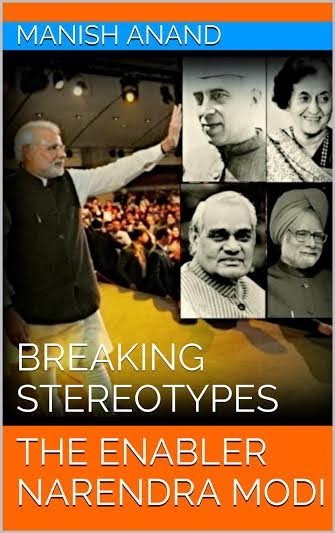
ENABLER NARENDRA MODI
Manish Anand in his book: “THE ENABLER NARENDRA MODI: BREAKING STEREOTYPES” describes Modi as an Emperor of Indian democracy. The author prefers not to draw a parallel but goes on to emphasise that Modi has surpassed the stature of Indira Gandhi of 1971 when she was India’s most powerful leader and had unveiled a single party rule in the country. Modi’s position is both ominous and providential, he says adding his position could be ominous because he may throttle dissent and cause serious damage to Indian democracy. At the same time it could also be providential because he can guide India onto a new path and liberate the shackled potential of the country.

In the preface, Modi has been described as “arguably” India’s first non-Congress Prime Minister. To drive home the point Manish says there were seven Prime Ministers of India, who headed non-Congress governments. Even Atal Bihari Vajpayee of BJP was Prime Minister for about six years. Yet, Modi is the first non-Congress Prime Minister in the true sense. Congress in India is not just a political party but a culture. And that culture was seeded deep into Indian democracy by Indira Gandhi. Her stature was such in her prime time that she ensured Constitution Amendment (42nd) to give India the character of a welfare state. All her successors, barring Modi, bore her imprints in their statecraft.
Carrying forward the argument Manish underscores how PV Narsimha Rao, ably assisted by his Finance Minister Manmohan Singh, sought to force open the window to the world, which was further carried forward by Vajpayee, they could not lay their hands on a formidable electoral template. Both were consequently rejected by the people. Both suffered from contradictions. They wanted to write new chapters in Indian economy and polity yet could not shun the ideological imprints of Indira Gandhi fully. Rao was a Congress man, but had vision to think beyond the Nehru-Gandhi bank of party ideas. Vajpayee was an RSS man, but had co-opted socialists, who were non-Congressmen for just namesake. Vajpayee was a minister in the Morarji Desai Cabinet. The old man was a hardcore Congress man and a rival of Indira Gandhi in her party. Vajpayee propped up VP Singh as Prime Minister also with the support of the Left parties. VP Singh had spent his life in the Congress and quit the party to head the Janata Party, which was essentially a loose confederation of provincial caste chieftains. Vajpayaee in his thoughts was centrist, with little leaning to the right.
In this backdrop, Manish goes on to examine the Congress party and what it stands for. Congress essentially is a political culture wherein the power of decision making is centralized. Popularly it is called a ‘High Command’ culture. This bears strong imprints in the statecraft. Even though India is a Union of states, with much thrust on federalism, Indian statecraft essentially is of centralized planning and decision making. The Centre decides what the states should do. The Centre decides how much money states should spend and under what heads. The Centre decides what laws states should have.
The author has illustrated the point vis-a-vis the Congress by drawing attention to the Indian Parliament enacting a law on acquisition of land in 2013, which was actually a political legislation thrust upon the government due to Rahul Gandhi’s obsession to do the politics of land. Land is a state subject and all state governments have their own respective policies or laws on acquisition of land. Then what was the need for the Centre to enact a law on land and whose amendments Modi is desperately seeking, because he believes it has forced a lock-down on development. If not for Rahul Gandhi ambushing Bhatta-Parsaul to throw his weight behind arguably relatively rich farmers of western Uttar Pradesh, India may have continued with the British time law on acquisition of land. The basic idea is that the Centre essentially lacks trust in state governments to be fair in dealing with its people. And that must sound ludicrous, because the state governments have more connect with the people than the state.
Carrying forward the argument, Manish says Modi is the first non-Congress Prime Minister because he has not been touched by the ideology and culture of the grand old party. Because he was chief minister of Gujarat for about 12 years with strong majority in the state Assembly. He never needed to bend even little to allow Congress to cast its imprints on him. Congress and New Delhi are a lot similar, because they too have the same culture.

The book, by Manish, who is a seasoned journalist covering the political beat for The Asian Age in Delhi, is a treatise on Indian politics and an in-depth analysis of the political philosophy and style of working of Prime Minister Modi and what sets him apart from his predecessors when it comes to vision and setting the agenda for the nation. --------- Book review by Newsroom24X7 http://newsroom24x7.com/2015/06/02/the-enabler-narendra-modi-breaking-stereotypes/

Friday, May 16, 2014

Turning of the wheel of time

A decade back India's most admired politician Atal Bihari Vajpayee could not believe that the people had rejected him. That six years of "good works" could not impress people seemed beyond his comprehension.

In his moments of disbelief, his friend and colleague Sharad Yadav visited him one evening in 2004 just after the Lok Sabha elections. "Aap bhi haar gaye (you too lost)," Vajpayee sighed at the sight of the socialist. 

"Aapko to maaloom hai ham kis liye haare...(you know why we have lost)," gushed Yadav.

Vajpayee, with a sense of rejection, sat down to chat with his former Cabinet colleague. They concurred, that the NDA government would have retained power in 2004 had Gujrat chief minister Narendra Modi been punished for the post-Godhra riots in 2002.

"This country did not re-elect Vajpayee because he could not act against Modi. People forgot all the good works of Vajpayee and punished him for the (mis)deeds of Modi. Yeh desh Modi ko kabhi PM nahi bana sakta (this country can never make Modi a PM)," Yadav told this blogger last year, after his party, JD (U), had snapped 17 years long relations with the BJP.

Yadav has lost another elections from the same Madhepura Lok Sabha seat in Bihar.

In 2004 he had lost to RJD's Lalu Prasad. Now, he has lost to Rajesh Ranjan alias Pappu Yadav of the RJD. And, Madhepura where Yadavs consider themselves to be too intellectual to elect a muscleman has exactly done so.

But Vajpayee is no more in his senses to receive Yadav and ask him why he lost another elections. India's most admired politicians for many decades no more recognizes people and at the most he smiles at those who go to meet him.

However, if Vajpayee had been in his senses, he would have again been bewildered to see that India has elected Modi for Prime Ministerial job. That too with a number so stunning, that the whole Opposition may stay in shock for quite longer time.

And with his insight he would have known that his belief in 2004 of having lost re-elections due to post-Godhra riots and his inability to act against the "rogue" chief minister was so off the mark.

That the 2004 NDA defeat had much to do with arrogant "India shining" campaign and sheer arrogance of Pramod Mahajan were lost to majority of media, who were blinded by stereotyped campaign against Modi and now hopefully seeks to rediscover their sight, after the people have given their verdict. 

The wheel of time has turned.

Now, India's most demonized politician for a decade is all set to be sworn in as Prime Minister. He inspires so much of hatred in his rivals, that Congress president Sonia Gandhi and her son Rahul Gandhi do not consider proper to take his name on their lips. And true to the character of the Congress, other leaders of the party ape the mother-son duo to the hilt.

But India has moved much beyond the comprehension of Sonia Gandhi and her son. And by the time they would realize that India is no more a country of people seeking free rice and wheat, Modi would have delivered fatal blow to the very roots of the Congress.

An unemployed educated in Bhagalpur, Bihar.
Last two and a half decades of Indian democracy saw willy politicians  putting fetters of "secularism" to the people.

In the garb of protecting India's secularism, these willy politicians institutionalized dynasty in Indian politics. And to perpetuate their "secular" politics and safeguard dynasties, they took an ultra-Left turn for worse. 

The game-plan may have lasted a little longer if not for P V Narsimha Rao opening up India's windows to the world.

That Manmohan Singh was such a gifted Finance Minister under Rao and such a wasted Prime Minister under Sonia Gandhi should surely be a matter of another commentary, but he did help India see enormity of opportunities, which lied on the path of development.

In those frosty years of 1990s, India and its people had seen and read progress made by South-east Asian nations. And they rightly thought and aspired that India too could do much better than the smaller South-east Asian nations. 

Furthermore, Vajpayee gave wings to dreams of teeming millions of people. And then the A P J Abdul Kalam phenomenon happened. This dreamy man made Indians not only dream but even chase them.

And he made a lot of people believe that India would be a developed nation by 2020.

But Vajpayee was ousted, and, with the support of the Left, the Congress led United Progressive Alliance (UPA) came to power in 2004. The Left painted the UPA in deep red colour.

The dream of India becoming a developed nation by 2020 was thrown into a dust-bin and the country returned on the path traversed in 1980s.

If the Left was not enough, Sonia Gandhi packed her National Advisory Council (NAC) with ultra-Leftists and jhollawaalas who ran NGOs here and there.

And they believed that ensuring almost free rice and wheat to 75 per cent population of the country was the job for which there should be a government in New Delhi. 

A village in Itawa (UP)
A whole decade was lost. A generation soaked themselves in anguish at the lost opportunities.

The colleges graduated skilled professionals, who sought jobs to sell soaps.

Government stopped recruiting and corporate began laying off.

And India soon had an army of unemployed and under-employed and improperly employed mass of youth cursing each and every one on government and politics.

India had been such a paradox from 2004-14, that the posterity would ask, how could so many fools ruled the country at the same time. And the younger generation knew better than the most, that they could not afford to waste another decade chasing the discarded Russian ways of governance.

In Modi, India has seen a hope to redeem itself. And, he as a true politician had the measure of the pulse of the nation before any one else had. He knew that there is a lot of anger in India, which is aspirational. 

And, the "culprit" who cut short the innings of Vajpayee presented himself as the man who could empathize with anger of the nation and yet jacked up aspirations manifold. But he carried the track-record, which made the people believe each word that he uttered.

"A business house based out of Kolkata had applied online to Gujrat government for setting up a plant in the state," said a senior Samajwadi Party leader, who tried to drive home the point why Modi was connecting with the people.
A couple of days later, mobile phone of the businessman rang and to his hello, the man on the other side said, that he was Narendra Modi speaking. Still in shock, the businessman heard Modi asking him if he could come to Ahmedabad next day for a 2.30 PM appointment.

He readied a suitcase of files to make presentation and met the appointment. As he spread out his files on the table, with Modi sitting on the other side, Gujrat CM told him, that the papers could be put back in the suitcase. 

"This is a three-page MoU, which we have prepared, wherein we have mentioned what all support the state government would provide for your proposed plant. If there is anything missing, you can let us know," Modi told the businessman, who found that there was nothing missing. And the MoU was signed there and then.

"Now, tell me which chief minister in India works like that and if he is able to connect with the people, why should any one complaint," the SP leader told this blogger.

Arguably, 2014 verdict is a body blow to practitioners of politics of secularism in Gangetic plains of UP and Bihar. The only other state where this brand of politics could survive even after the Modi Tsunami is West Bengal.

That the mercurial wonder lady of Indian politics has survived Modi onslaught is true, but is surely not going to be her permanent feat. And she will have to face a much bigger push of developmental politics in 2016 state elections, which is written clearly on the wall. 

Some dreams never die.
The wheel of time has turned and has turned against all those who take people for a ride in the name of saving India's "secularism". 

And not only Vajpayee was wrong in diagnosing defeat of NDA in 2004 even his comrade L K Advani has been utterly out of sync with time.

You can't flog one man all years for one riot irrespective of the fact whether he was complicit or not. There has been 179 communal riots under the watch of Akhilesh Yadav in UP since 2012 and still this chief minister is "greatest custodian of secularism".  

Hypocrisy has an expiry date. And it lasts a little longer only in places, where people are hell-bent to commit suicide.