Showing posts with label Indira Gandhi. Show all posts

Wednesday, July 08, 2015

Book review: The enabler Narendra Modi

It has been a year since Narendra Modi came to power after leading the Bharatiya Janata Party to a landslide victory in the 2014 parliamentary election.
Modi in a few months after his inauguration shut down the Planning Commission, which by default subverted the idea of India being a federal democracy. All chief ministers as a matter of routine would line up each year to get their annual plan approved by the Planning Commission. Modi has in place inaugurated NITI Aayog wherein the chief ministers head sub-groups on various subjects. But most importantly Modi assured from the ramparts of the Red Fort, that he would ‘neither take bribe nor allow others to do the same (naa khaaoonga, naa khane doonga)’. No Prime Minister before him acknowledged the cancer of corruption and owned up responsibility to crush it down. A year has passed by since the inauguration of Modi and the economy has resumed its journey on the upward trajectory, but the real-estate prices in Delhi and satellite towns around have slumped by at least 20 per cent. The real-estate in Delhi zone thrived because the black money was in ample supply. The tap appears to have been turned off and there is tangible effect on the grounds.
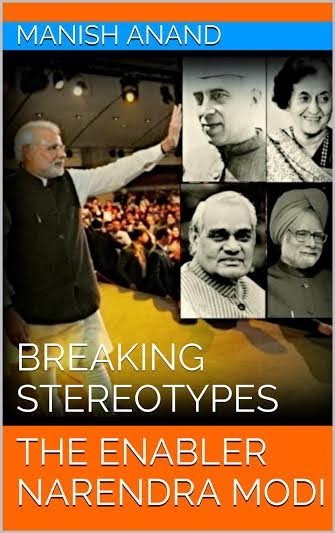
ENABLER NARENDRA MODI
Manish Anand in his book: “THE ENABLER NARENDRA MODI: BREAKING STEREOTYPES” describes Modi as an Emperor of Indian democracy. The author prefers not to draw a parallel but goes on to emphasise that Modi has surpassed the stature of Indira Gandhi of 1971 when she was India’s most powerful leader and had unveiled a single party rule in the country. Modi’s position is both ominous and providential, he says adding his position could be ominous because he may throttle dissent and cause serious damage to Indian democracy. At the same time it could also be providential because he can guide India onto a new path and liberate the shackled potential of the country.

In the preface, Modi has been described as “arguably” India’s first non-Congress Prime Minister. To drive home the point Manish says there were seven Prime Ministers of India, who headed non-Congress governments. Even Atal Bihari Vajpayee of BJP was Prime Minister for about six years. Yet, Modi is the first non-Congress Prime Minister in the true sense. Congress in India is not just a political party but a culture. And that culture was seeded deep into Indian democracy by Indira Gandhi. Her stature was such in her prime time that she ensured Constitution Amendment (42nd) to give India the character of a welfare state. All her successors, barring Modi, bore her imprints in their statecraft.
Carrying forward the argument Manish underscores how PV Narsimha Rao, ably assisted by his Finance Minister Manmohan Singh, sought to force open the window to the world, which was further carried forward by Vajpayee, they could not lay their hands on a formidable electoral template. Both were consequently rejected by the people. Both suffered from contradictions. They wanted to write new chapters in Indian economy and polity yet could not shun the ideological imprints of Indira Gandhi fully. Rao was a Congress man, but had vision to think beyond the Nehru-Gandhi bank of party ideas. Vajpayee was an RSS man, but had co-opted socialists, who were non-Congressmen for just namesake. Vajpayee was a minister in the Morarji Desai Cabinet. The old man was a hardcore Congress man and a rival of Indira Gandhi in her party. Vajpayee propped up VP Singh as Prime Minister also with the support of the Left parties. VP Singh had spent his life in the Congress and quit the party to head the Janata Party, which was essentially a loose confederation of provincial caste chieftains. Vajpayaee in his thoughts was centrist, with little leaning to the right.
In this backdrop, Manish goes on to examine the Congress party and what it stands for. Congress essentially is a political culture wherein the power of decision making is centralized. Popularly it is called a ‘High Command’ culture. This bears strong imprints in the statecraft. Even though India is a Union of states, with much thrust on federalism, Indian statecraft essentially is of centralized planning and decision making. The Centre decides what the states should do. The Centre decides how much money states should spend and under what heads. The Centre decides what laws states should have.
The author has illustrated the point vis-a-vis the Congress by drawing attention to the Indian Parliament enacting a law on acquisition of land in 2013, which was actually a political legislation thrust upon the government due to Rahul Gandhi’s obsession to do the politics of land. Land is a state subject and all state governments have their own respective policies or laws on acquisition of land. Then what was the need for the Centre to enact a law on land and whose amendments Modi is desperately seeking, because he believes it has forced a lock-down on development. If not for Rahul Gandhi ambushing Bhatta-Parsaul to throw his weight behind arguably relatively rich farmers of western Uttar Pradesh, India may have continued with the British time law on acquisition of land. The basic idea is that the Centre essentially lacks trust in state governments to be fair in dealing with its people. And that must sound ludicrous, because the state governments have more connect with the people than the state.
Carrying forward the argument, Manish says Modi is the first non-Congress Prime Minister because he has not been touched by the ideology and culture of the grand old party. Because he was chief minister of Gujarat for about 12 years with strong majority in the state Assembly. He never needed to bend even little to allow Congress to cast its imprints on him. Congress and New Delhi are a lot similar, because they too have the same culture.

The book, by Manish, who is a seasoned journalist covering the political beat for The Asian Age in Delhi, is a treatise on Indian politics and an in-depth analysis of the political philosophy and style of working of Prime Minister Modi and what sets him apart from his predecessors when it comes to vision and setting the agenda for the nation. --------- Book review by Newsroom24X7 http://newsroom24x7.com/2015/06/02/the-enabler-narendra-modi-breaking-stereotypes/

Thursday, May 28, 2015

THE ENABLER NARENDRA MODI

AVAILABLE ON AMAZON
BY 1971 Indira Gandhi was perched as an empress of Indian democracy. She had established a political cult with no parallel. After about six years of flux in Indian politics, Indira Gandhi had unveiled a one party rule. She had no challengers. She had run her surgical knife on Pakistan. She midwifed birth of Bangladesh with a surgeon’s precision. She lifted the doom from the conscience of millions of Indians who suffered collective national depression following India’s humiliating defeat at the hands of mighty Chinese army in 1962. The Opposition hailed her as ‘Durga’ (symbol of Shakti, power).

Destiny could not have been more kind to Indira Gandhi. She had her firm grips over absolute power. She was the face of India’s resurgence. She effected fundamental changes in Indian democracy and economy. She gave Indian democracy twin legs of secularism and socialism by incorporating them in the Preamble of the Constitution. India firmly embraced an identity of a welfare state.

The mighty lady is arguably the mother bank of ideology of not only her party Congress, but also the whole lot of socialist parties which dot vast swathes of the country. Pandit Jawahar Lal Nehru had groomed her politically and ideologically. He shaped his daughter’s worldview. Destiny was much kinder to her, for Indira Gandhi not only grew in the bosom of Pandit Jawahar Lal Nehru but was also adored by Mahatma Gandhi.

Pandit Jawahar Lal Nehru was an internationalist. He was arguably the father of industrial India. His daughter was a case in contrast. She was more of a nationalist than an internationalist. Her father co-opted industrial world. She shunned them. Her father knocked at the doors of United Nations for solutions to vexed Kashmir issue. She cared the least for any international power. She was uncluttered and shunned lures to romance an international stature. She charted her own course.

Mahatma Gandhi was arguably her ideological father. Nehru dreamt of India having large industries and equitable distribution of wealth. She embraced his ideas in her statecraft. She anchored her politics on the plank of anti-poverty measures. She was no believer in large industries and the free market economy taking care of the poor. She unapologetically disowned Nehruvian economy through industrialisation and instead believed in direct transfer of wealth to poor.

FOUR and a half decades later Narendra Modi is perched as an emperor of Indian politics. Even his political rivals privately admit that Modi has surpassed the 1971 stature of Indira Gandhi. They firmly believe that India is on the cusp of a single party rule for quite a long time. He has eclipsed all his rivals. He has a grip over absolute power. His stature is a notch larger than that of Indira Gandhi of 1971.

Indira Gandhi incidentally had to struggle through her political course, as she was a contemporary of a galaxy of stalwarts not only within the Congress but outside. If Kamraj and Morarji Desai were her challengers in the Congress, she had to politically outweigh leaders like Jayprakash Narayan, Charan Singh, George Fernandes, Atal Bihari Vajpayee et al. But Modi seems to be lucky as he has none to challenge him inside his party and outside as well on a scale as faced by Indira Gandhi. 

NARENDRA Modi is also arguably the first non-Congress Prime Minister of India. There were seven before him from non-Congress ranks, including BJP's Atal Bihari Vajpayee. But they all bore strong ideological footprints of Congress and carried the legacy of Indira Gandhi in their thoughts, beliefs and statecraft. Modi stands apart because he carries no Congress baggage in thoughts and actions. He could do so because, he does not belong to New Delhi, which has a character of thinking India being just an aggregate of various bungalows in Lutyens' zone.   


In 1991 when Narsimha Rao took over the reign of the country, India was reeling under deep economic crisis. India had to mortgage gold to meet the requirement of current account deficit and pay interest on international borrowings. Rao appointed Manmohan Singh as his finance minister and gave him a template to revive the economy. Singh unleashed a slew of reforms and broke the shackles to put India on the path of free capitalist economy. 

A lot of systemic changes were brought in without being conscious of the poor, as the belief was in growth rate and trickle down theory. No doubt growth was achieved, but a vast population were left on the margins, leading to rise of Left Wing Extremism. Most of the analysis have revealed that liberalisation and LWE witnessed parallel growth. Later, when Vajpayee took over, he and his finance minister Yashwant Sinha followed the same path and Indian growth story reached to its zenith (9+ growth).  

In 2004, the Vajpayee government and the ruling party launched “India Shining” campaign. But it backfired. The left leaning and socialist forces galvanised against the ruling NDA. Even Congress sided with Left policies and managed to become the nucleus for such forces to dislodge the Vajpayee government.

However, it was a travesty of history that the architect of liberalisation, Dr Manmohan Singh, became the leader of the left leaning group of parties. Singh was anointed the Prime Minister of India. As the Manmohan rule progressed, it had the imprint of Sonia Gandhi and the four left parties with more than 60 seats in Lok Sabha supporting the government. Here again Manmohan Singh did not work on his own template, as was the case when he had been the finance minister. Then he worked on Rao’s template’ and as Prime Minister he worked on a combined template of Sonia Gandhi and Left Parties. Thus began the one decade of India being a ultra-welfare state, as the UPA government was repeated in 2009. Several pro-poor direct transfer and right based policies were put in place. They included like MGNREGA, RTE, RTI and food security act.

Now with Narendra Modi at the helm, it seems the state has drifted from its path of ultra-welfare activities and instead sowing seeds of being an enabler for people to avail benefits of the fruits of development. In case of most of the UPA flagship schemes, Modi did not discontinue, but has showed least interest in them in their implementation. Today nobody is talking about MGNREGA and even if some talks are made, they are all about non-payment of wages to labrourers. Even Right to education seems to have become a non-issue. Right to Information too has become irrelevant as many thousand applications are reported to have been pending in the office of CIC. 

In place of these the new government has launched several social sector schemes to empower people living on the margin. But in none of them the state is directly contributing anything. Be it Jandhan Yojna, or Pradhan Mantri Bima Yojna or for that matter Atal Pension Yojana, the basic criteria to avail them is to contribute, though very meager. Therefore, the Modi is government, in the name of welfare, has only been creating platform for people to come and join with their own money and get the benefits of the schemes. And that is the template of an enabler Narendra Modi India is witness to after the 2014 verdict.

The book is available in digital format at following link on Amazon:

https://www.amazon.in/ENABLER-NARENDRA-MODI-BREAKING-STEREOTYPES-ebook/dp/B00YFLMSBE

Those who don't have Kindle device can also read by downloading the Kindle App by clicking: For android phone http://bit.ly/19c6Xpm for Apple phone/ IPad http://apple.co/1MrRaF5 for PC http://amzn.to/1ImLwl0

Saturday, April 26, 2014

Chasing Indira mirage

Political icons outlast their lives. They are more powerful even long after they are dead. 

John F Kennedy is still powerful in memories of Americans. That Bill Clinton during his first bid in the US Presidential elections got quite a leg up, after Americans found that he looked like Kennedy is being talked about far from Washington and in the unlikely land of mother of all democracy, that India is, should not come as surprise. Because what Kennedy was for America, Indira Gandhi was for India.

And the last hope of Congress and of Nehru-Gandhi dynasty and also of numerous other dynasties in India seem pinned in Priyanka Gandhi Vadra. Even before the noise in Congress for Priyanka becomes louder, her fans are growing in numbers among leaders of regional parties.  

That BJP's Prime Ministerial candidate Narendra Modi has emerged as the numero-uno threat to dynasty is being admitted in the political corridor and with quite considerable concern. Modi seems to have taken BJP to such places where the party never existed and that makes him a foe of regional forces as well. 

Arguably, Congress vice-president Rahul Gandhi has lost his political plot. And as if Indian politics is still that gripping soap-opera, his sister and occasional campaigner Priyanka Gandhi Vadra is showing quite an eagerness to jump into politics. 

It will be a mistake not to see a pattern, because there is a clear orchestration to prop up her into the political arena.

"Rahul kuch jyaada hi make-up kar liya tha...bilkul babua lag raha tha...16 ke baad ham khul kar bolenge ki Priyanka ko leading role lena chahiye (Rahul looks a kid...after 16th May, we will openly demand a larger role for Priyanka," said a top ranking Samajwadi Party leader, who liasen with top Congress leaders.

Regional parties have thrived with the weakening of the Congress during the last three decades. They built dynastic political parties on caste identities and survived even after they faced corruption charges. 

But the lurking decimation of Congress in the ongoing Lok Sabha elections is being seen as a clear threat to various dynasties. They apprehend that if Nehru-Gandhi dynasty can be politically made irrelevant, they will face the similar fate in coming months or years. And, hence, it makes a strong case for rallying behind Priyanka.


"India is full of emotional people. Priyanka styles on Indira's lines. People can flock to her if she jumps into active politics," confided a seasoned politician. 


From Jammu and Kashmir to Punjab to Haryana to Uttar Pradesh to Odisha to Jharkhand, Indian democracy tells the sorry tale of electoral politics being hijacked by dynasties. While Pandit Jawahar Lal Nehru pushed his daughter Indira Gandhi into politics without a clear motive to establish a dynasty, she later did make it happen in 1980s. 
And since then the beneficiaries of the JP movement formed dynasties of their own. So, Mulayam Singh Yadav clan in Uttar Pradesh, Lalu Prasad in Bihar, Devi Lal in Haryana, Shibu Soren in Jharkhand established their hegemony in their respective states. 
But the rise of Narendra Modi has sent shock waves in these dynasties. "After decimating the Gandhi dynasty, Modi will next target dynastic politics in states. He poses serious threats to all those who have carved out political dynasties on caste identities. 
Therefore, all such leaders will make a beeline to demand a larger role for Priyanka after the verdict for the Lok Sabha elections is out," confided a senior Samajwadi Party leader.Arguably, Priyanka Gandhi Vadra could be an easy target for Modi to further crush the Congress. 
"Will she not being a Mrs Vadra prove counterproductive for the Congress?" To this, the reply comes: "This is a land where the likes of A Raja wins with record margin. So, being Mrs Vadra does not matter much. People are emotional and if Priyanka can reinvent herself as Indira, there could be a recovery," said one advocating a larger role for her.
Incidentally, a weak Congress gains a lot of friends. And in the coming months the Congress may be pleasantly surprised to find a lot of new friends. They may also like to do business together. And that will happen because when faced with an existential crisis, lesser foes do not mind joining hands together. 
Thus, Navin Patnaik can have an understanding with Congress, as BJP beings to make deep inroad in Orissa. Mamata Banerjee may also revive her relations with Congress, as ground reports suggest BJP likely to fetch a minimum 15 per cent vote share in West Bengal in the Lok Sabha elections. Also, Mulayam will have no choice but to seek help from the Congress to keep the rising BJP in UP at bay.  
But the Congress will not be in a hurry to launch Priyanka into active politics so soon. That Rahul will get another five years to re-build the Congress is acknowledged in the party. And, therefore, the Congress will like to titillate the people with Priyanka's name for a while. 
You don't run all your best horses in the same race.

Wednesday, April 16, 2014

Red ant eaters

Late Prime Minister Rajiv Gandhi did not believe that a lot of people were eating red ants in many districts of Orissa in 1980s during famine. 

Three decades later, there are still people in parts of West Bengal and Orissa who eat red ants and their eggs. That, off course, is not a delicacy. but extreme human survival compromises. 

And these men and women are mostly Scheduled Castes and Tribes (SCs & STs). That they remain at the bottom of the development pyramid is a telling blow to the road-map, which Dr Bhimrao Ambedkar and Mahatma Gandhi had laid as part of the "Poona Pact". The duo may not have imagined that their road-map would be hijacked by pseudo leaders, who in later decades, would exploit their castes to build fortunes for themselves.

On the outskirts of Lucknow and in the midst of a paddy field, three men were idling away their time with beedi. That was on the eve of the 2012 Uttar Pradesh Assembly elections. Two of them sat on a raised cemented platform, while the third squatted at a distance on the ground. The two were Yadavs and the squatter was a Dalit. But they all worked for the state government and were fourth grade employees. For over two weeks, they all did the same job; that of covering larger than life size statues of "Behen" Mayawati in and around Lucknow.

"We will vote for Netaji (Mulayam Singh Yadav), but he will vote for Mayawati. You can ask him. He will vote for her despite covering her statues himself for over a fortnight," said one of the Yadavs. The squatter shyly confirmed. That he will do so, because, he said, Mayawati is the honour of his caste.

In five years that she ruled Uttar Pradesh with an iron fist, all that Dalits got have largely been impressive BSP party offices in their villages. Dalits in UP villages, while living in mud-hut like shelters, take pride in these double storey offices of the BSP. Even though Mayawati ran a scheme called Dr Ambedkar Gram Jyoti Yojana in which the state government gave Rs one crore for a village's development, the sorry tale of embezzlement is there for all to see. 

In the close neighbourhood, wily Nitish Kumar attempted his grand plan to politically insure his party by stratifying Dalits into Mahadalist. Though there was nothing Maha (great) about this political move, what he did was weaning away the support base from another Dalit political contractor Ram Vilas Paswan.  

Sugriv Harijan
But nine years after Nitish carved out Mahadalit for his political stability, lot of these people look much worse on the ground. "All that we have got in the name of Mahadalit is one radio set for a family. We were better off till government made us Mahadalit," quipped Sugreev Harijan, 65, of Kulharia Mahadalit village in Banka district of Bihar.

Incidentally, Nitish claimed that he distributed land to Mahadalit but in two villages of such people none had got either land or job. And they mostly work as labourers for which MGNREGA (Mahatma Gandhi National Rural Employment Guarantee Act) comes handy.

Arguably, Nitish Kumar in the name of Mahadalit proved a bigger villain for them, as he allowed country liquor shops to be opened up in their villages. So, Mahadalit youths, who have got education till school, will not work on farm field and in the absence of regular jobs they will idle away their times during days and by dusk will be high on country liquor. And, while the most productive age group has arguably become a lazy class, senior citizens among them toil hard on the hard land.

Mahadalit MGNREGA labourers 

So, a little walk through a farm field full of human defecation takes one to about two dozen Mahadalits working to dig land for minor irrigation. And they reveal the paradox in their lives, as men are mostly 60+ working with their daughters-in-law. None of them are Mahadalit male youth.

"My son is a graduate but is jobless and a drunkard. At this age, I work as a labourer to feed him and his family. If the liquor shop was not opened so near our homes, he may have worked for livelihood," said Bharat Das, 65.

In another Mahadalit village in Bhagalpur district of Bihar, Manoj Kumar, after having returned from Delhi where he worked as compounder, has opened a clinic and prescribes medicines to villagers, who have no access yet to trained doctors. Local BJP MP Putul Devi believes at least there is someone to give medicines for minor ailments.

If these Dalits still struggle with their livelihoods, one can not resist to admit the fact that they have been victims of Nehruvian politics perpetuated by his daughter Indira Gandhi by turning them into a herd for votes. And to ensure that they remained a herd, they have just been given enough doles in last six decades just to survive. Nehru-Indira model was later hijacked by the likes of Mayawati, Nitish Kumar but no change took place in their real motives.

That if Dalits break off from their sub-poverty level, their aspirations could split the herd, which makes a poor political sense. But there lies the failure of the nation to allow a great number of people to live sub-human lives. And so the red ant eaters live in India.

Saturday, March 02, 2013

The awakening


Thirty years after Indira Gandhi gave NABARD, P Chidambaram promises to give financial wings to the women to fly to their real freedom. The “all women” bank is much more than what it’s being taken for by a large number of people. It's about means to becoming part of society in true sense, which otherwise is handicapped, standing on one leg, with other being crippled. 


Society stands on two legs. Men and women constitute the two legs. A nation is made of societies. India story except for the last one decade has been that of a nation running on one leg. The other leg is sluggish and laggard for being not put to use for centuries. In a sense, India had been marching ahead with a self-imposed disability.

Finance Minister P Chidambaram has taken two distinct steps to bring the “other leg” to its full vigour. First is an all women bank and secondly a Rs 1,000 crore fund of women safety. Together they address key concerns of women – financial exclusion and lack of security. In the absence of financial inclusion and a sense of security, hoping women to enjoy their freedom is a mere day-dreaming.

Not only India, a host of countries, including Pakistan, Afghanistan, Arab world, whole of Africa, claim to firmly stand on their feet; but with one leg largely crippled and paralyzed. Consequently, they all present a picture of refusing to wake up from their medieval age slumber.

Bangladesh is a case in contrast. The youngest nation led by two powerful women alternatively has been able to open large windows of awakening and development. While the Shahbag movement is ruling full steam, there is a clear sense that the youth there is hitting the Jihadi wall quite hard. The day the wall is brought down the region will surely breathe a new air of moderation and reason. If that happens, we shall reserve our congratulations for the powerful woman Prime Minister of Bangladesh – Sheikh Hasina.

Women can bring around revolution. There had been a number of revolutions, which were in nature of nations caught in implosion. But the one brought about by women invariably take the nations forward.

India’s Late Prime Minister Indira Gandhi too had seeded revolution for food security through green revolution. A revolution needs fuels of all kinds – human resources, technological breakthroughs and interventions, financial outreach, etc.

Thirty years back Gandhi gave India NABARD (National Bank for agriculture and rural development). This intervention triggered India’s robust agricultural march. Now India’s agriculture not only feeds more than a billion mouths but earns foreign exchange through export of foodgrains.

Another thirty years later since Gandhi’s deeds, Chidambaram promises to give financial wings to the women to fly to their real freedom. The “all women” bank is much more than what it’s being taken for by a large number of people.

However, Chidambaram’s measure has come a little late. Three years ago, the government had launched the National Rural Livelihoods Mission (NRLM) as Aajivika. The programme was based on setting up of a financial institution, with a corpus of over Rs 9,000 crores, to give support after support to women self help groups (SHGs). This, however, did not materialize. Predictably, the Aajivika too did not take off in the true sense.


But the Finance Minister has made some amends. The proposal to set up India’s first ever state owned bank by the women and for the women, with an initial support of Rs 1,000 crore, could just give a fresh lease of life to Aajivika.

The proposed “women all” bank is supposed to lend mostly to women and women-run businesses, which supports women SHGs and women's livelihood, that employs predominantly women, and that addresses gender related aspects of empowerment and financial inclusion.

The financial weakness has seen the women led SHG movement largely confined to four southern states -- Andhra Pradesh, Tamil Nadu, Kerala and Karnatka. These states largely benefit from the Central government’s annual funds for NRLM (RS 39,000 crore for 2012-13 but actually spent Rs 26,000 crore).

In the absence of financial support and lack of collateral to claim loans for the livelihoods activities, women in North and eastern parts of India have hardly gained from the government scheme for livelihoods mission (Aajivika).


Currently, India has about 25 lakh SHGs headed by women. They in all engage three crore women. The government is targeting to expand the SHGs from the current 25 lakh to 60 lakh in five years. The government hopes that seven crore women would engage in SHGs in five year’s time. So, the government is actually looking ahead to just double the strength and participation.


It’s here the proposed “all women” bank fits in the picture of India attempting to empower women. Such a bank nonetheless is neither novel nor first. The Pandiyan bank was the first “all women” bank launched in 1947 but later merged with Canara bank.

Thus, such a bank may over a period of time have the potential to transform Indian society and the nation too. It’s worth noting the contribution of women in heralding stability to Indian polity. The stable governments of Bihar, Madhya Pradesh, Chhatisgarh, Gujrat, Tripura, Delhi, owe a lot to women, who vote in a large numbers outnumbering their male counterparts.

So, the story may just be unfolding.